Skin is constantly renewing itself, and understanding how skin repair and collagen work together is key to maintaining healthy, resilient skin over time.
Every day skin responds to environmental stress, UV exposure, dehydration and natural ageing processes. When skin starts to look dull, feel less smooth or appear more tired, it is often a sign that the repair cycle has slowed down.
At the centre of this process is collagen, the structural protein that helps support firmness, elasticity and overall skin integrity. As collagen production naturally declines with age, the skin’s ability to recover and rebuild also changes. Understanding skin repair and collagen helps explain why supporting both stimulation and recovery becomes increasingly important over time
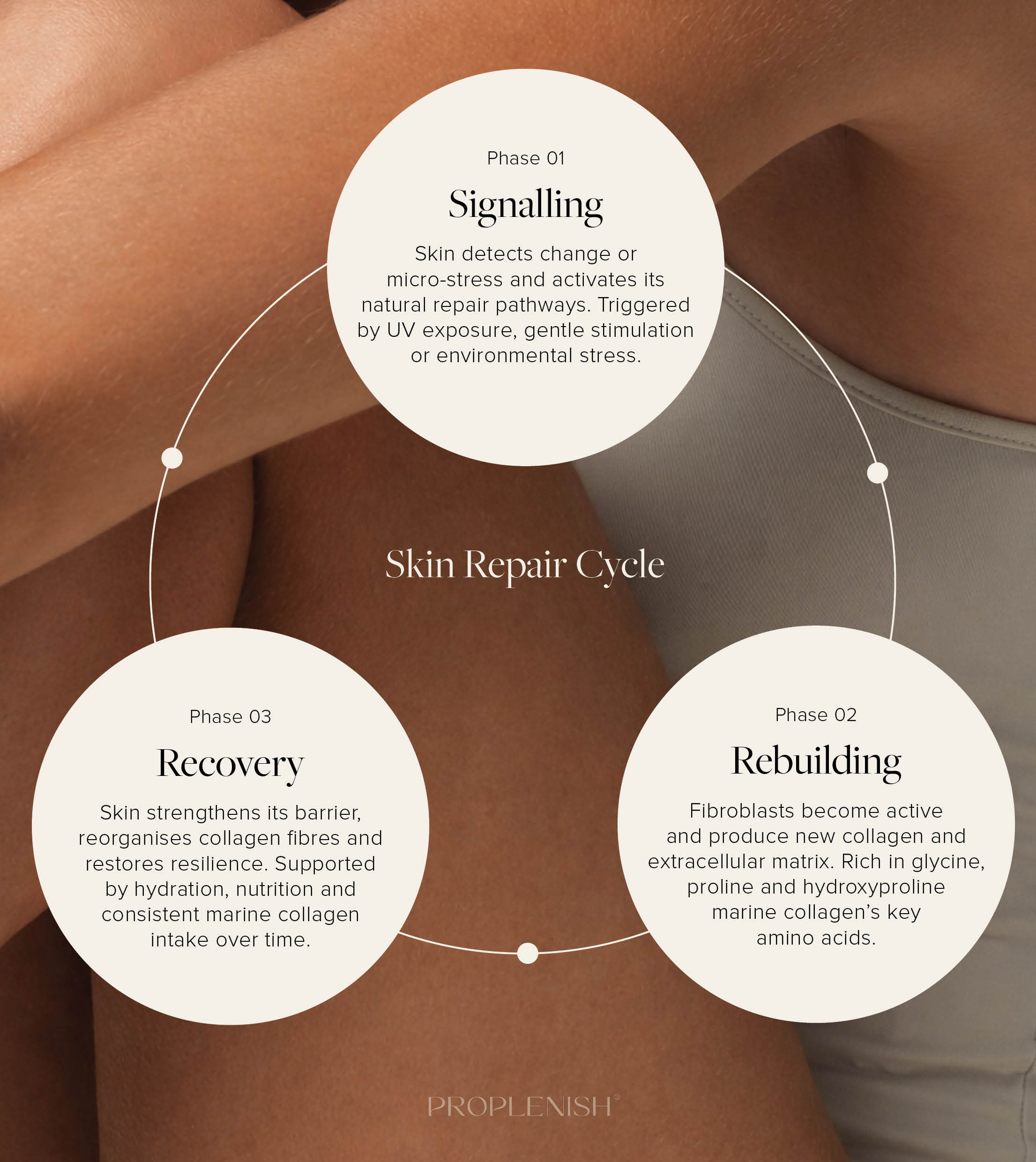
Skin repair is a highly organised biological process that occurs in stages whenever the skin experiences stress or gentle stimulation.
1. The signalling phase
Skin detects change or micro-stress and activates repair pathways. This can occur naturally from environmental exposure or from controlled skin stimulation.
2. The rebuilding phase
Fibroblast cells become more active and begin producing new collagen and extracellular matrix components that help restore skin structure.
3. The recovery phase
The skin strengthens its barrier, reorganises collagen fibres and works to maintain hydration and resilience.
Scientific research shows that controlled stimulation can activate wound-healing pathways associated with collagen synthesis and tissue remodelling, supporting the skin’s natural renewal process.¹
Many professional treatments and skin tools are designed around one simple principle, skin responds to signals.
Gentle stimulation encourages communication within the skin, supports circulation and activates natural renewal pathways. The goal is not to aggressively damage the skin, but to encourage the body’s own repair mechanisms.
This is why stimulation-based treatments have become popular in skin care. They work with the body’s biology rather than against it.
One of the most interesting concepts in modern skin treatments is controlled micro-injury, which is the principle behind procedures such as microneedling.
This does not mean harming the skin. Instead, tiny and precise disruptions are created in the upper layers of the skin to trigger a natural healing response. These small signals activate processes the body already uses to repair tissue.
When controlled micro-injury occurs, the skin responds by:
– activating inflammatory signalling (a normal and temporary stage of repair)
– releasing growth factors
– stimulating fibroblast activity
– encouraging new collagen and elastin formation
Over time, this process supports skin remodelling and improved texture as new collagen develops.
Research shows that microneedling stimulates collagen production through wound-healing pathways, encouraging dermal remodelling without removing the outer skin layer.²
The key point is this:
Micro-injury is simply the signal, repair is where real renewal happens.
The real changes occur during recovery, when the skin rebuilds and strengthens itself.
While stimulation initiates the process, recovery is where the skin actually rebuilds.
During this phase the body relies on:
– hydration and barrier support
– reduced inflammation
– consistent skin care
– amino acids required for collagen synthesis
Collagen is made from specific amino acids such as glycine, proline and hydroxyproline, which are essential building blocks used during tissue repair.³
This is why many skin professionals talk about balancing external treatments with internal support. Skin renewal is not a single event, it is an ongoing cycle that depends on how well recovery is supported.
Supporting skin repair and collagen production requires consistency rather than intensity.
Healthy-looking skin isn’t built in a single treatment, it’s supported through consistent renewal and recovery over time.
Collagen plays a central role in maintaining skin strength and resilience. As we age, collagen production naturally slows, and the repair process becomes less efficient.⁴
This can appear as:
– slower recovery
– reduced firmness
– uneven texture
– increased dryness
Supporting skin repair and collagen therefore involves looking at the whole picture, not just one treatment or one product.
Gentle stimulation may help activate renewal, but long-term skin health relies on supporting the rebuilding phase as well.
You don’t need aggressive treatments to support skin renewal. Consistency and balance are often more important than intensity.
A supportive approach may include:
– gentle skin stimulation as part of a professional or at-home routine
– maintaining hydration and barrier health
– protecting skin from environmental stress
– supporting collagen production through nutrition and lifestyle choices
Think of skin repair as a partnership between what you do externally and how you support your body internally.
Skin repair is a natural biological process that relies on both stimulation and recovery.
Gentle stimulation provides the signal for renewal, while recovery allows the skin to rebuild collagen and strengthen over time. Understanding how skin repair and collagen work together helps create a more balanced and sustainable approach to healthy-looking skin.
When external care and internal support work hand in hand, skin is better supported through every stage of its natural renewal cycle.
Does microneedling stimulate collagen?
Microneedling works by creating controlled micro-injury that activates the skin’s natural repair response, which includes collagen production.
Can I do microneedling at home?
Yes, at-home microneedling tools allow you to support your skin’s natural renewal process as part of your regular routine. The ProPlenish Regeneration Beauty Tool includes a microneedling attachment designed for safe, consistent home use, working alongside your marine collagen to support the rebuilding phase from both inside and out.
Why is recovery important after skin stimulation?
Recovery allows the skin to rebuild collagen fibres and strengthen its barrier, supporting long-term skin resilience.
References; 1.Campos V, et al. Microneedling: Advances and widening horizons. Dermatologic Surgery. 2018. 2. Aust MC, et al. Percutaneous collagen induction therapy: an alternative treatment for scars, wrinkles and skin laxity. Plastic and Reconstructive Surgery. 2008. 3. Shoulders MD, Raines RT. Collagen structure and stability. Annual Review of Biochemistry. 2009. 4. Varani J, et al. Decreased collagen production in chronologically aged skin. American Journal of Pathology. 2006.